No paper posted from 4 through 10 September 2026 directly designed a TADF emitter or PhOLED host. The useful evidence instead locates the failure boundaries of an OLED inverse-design workflow. Accurate single-molecule energies and oscillator strengths do not by themselves capture collective excitons in condensed phases, nonadiabatic behavior near state crossings, the joint generation of molecular size and three-dimensional structure, or failures outside a model’s benchmark distribution.
The week’s central result is an experimental comparison of five conjugated polymers. Their absolute homogeneous linewidths span roughly 20-90 meV, yet all show weak temperature dependence over the measured ranges. The absolute linewidth also depends on whether coherence or population is detected. The other seven papers extend that lesson into computation: reliability must be built through explicit representations, falsification tests, escalation to higher-level electronic structure, and a transparent account of quantum-measurement cost.
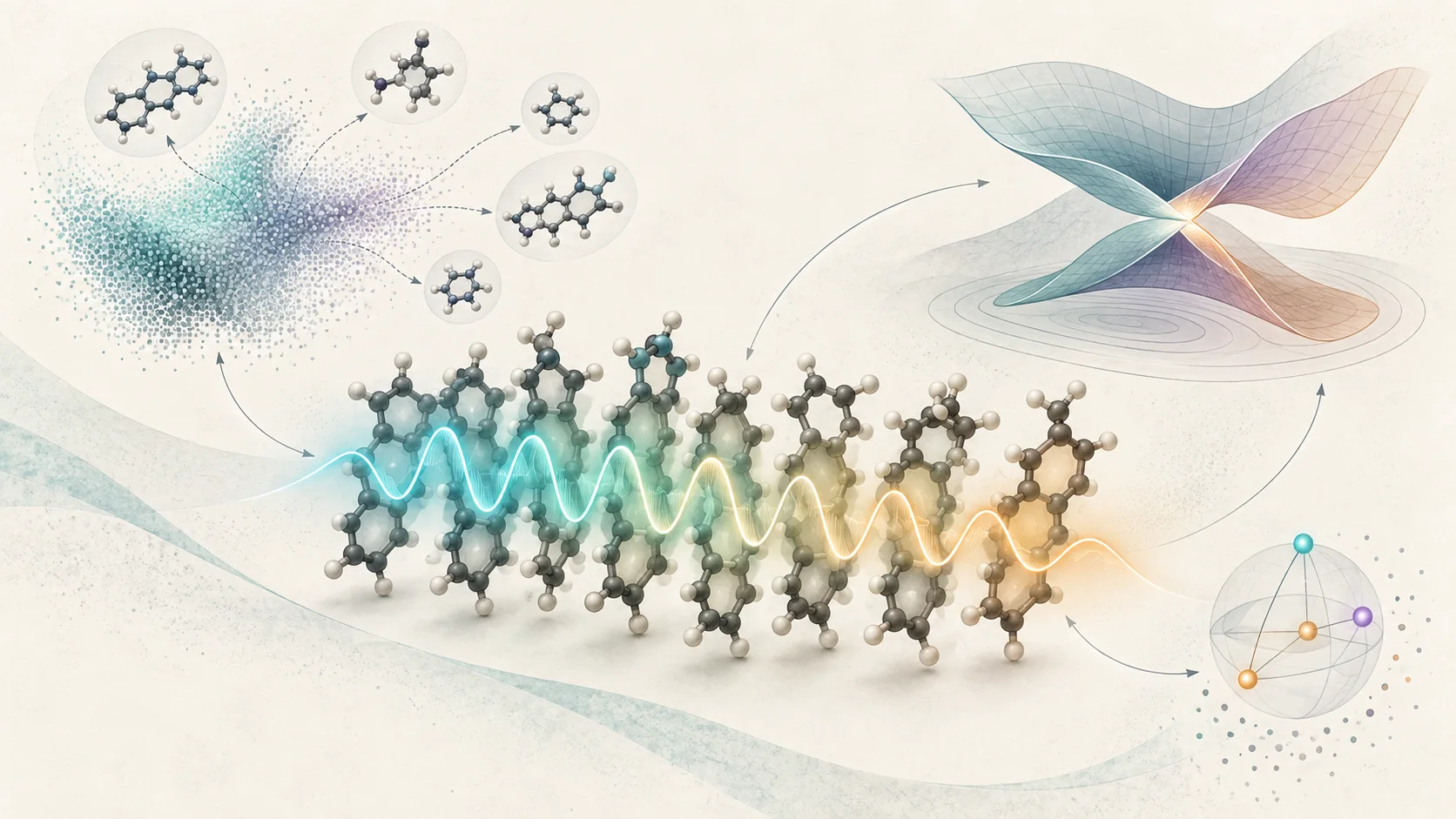
Figure 1. Conceptual illustration for this review. The central aggregate represents collective excitons and dephasing; the surrounding elements represent variable-size generation, state crossings, and quantum sampling cost. The generated molecules, potentials, and quantum motifs are not exact structures, measured morphology, quantitative surfaces, or executable circuits.
The layout-verified technical brief is available as a PDF download.
Ranked shortlist
- Collective excitonic structure governs weak thermal optical dephasing - the only direct condensed-phase photophysics experiment in the set.
- EF-TALFM - lets a fixed-dimensional latent determine molecular size and validates HOMO-LUMO-gap hits with DFT.
- MLIP Detective - searches for physically falsifiable failures beyond benchmark averages.
- DMRG-QD-NEVPT2 analytic derivatives - evaluates gradients and interstate couplings through a crossing on an 8 GB consumer GPU.
- Multipole splats - reframes optimized and inverted Kohn-Sham potentials as stable Hamiltonian-learning problems.
- OOD differentiable inverse design - combines a dynamics surrogate with physical refinement beyond the training-property range.
- QESEM water PES - reduces hardware bias on an IBM QPU while exposing a steep sampling cost.
- CASH-QSE - avoids remeasuring a classical CASSCF contribution, but its reported resource gains are idealized rather than hardware results.
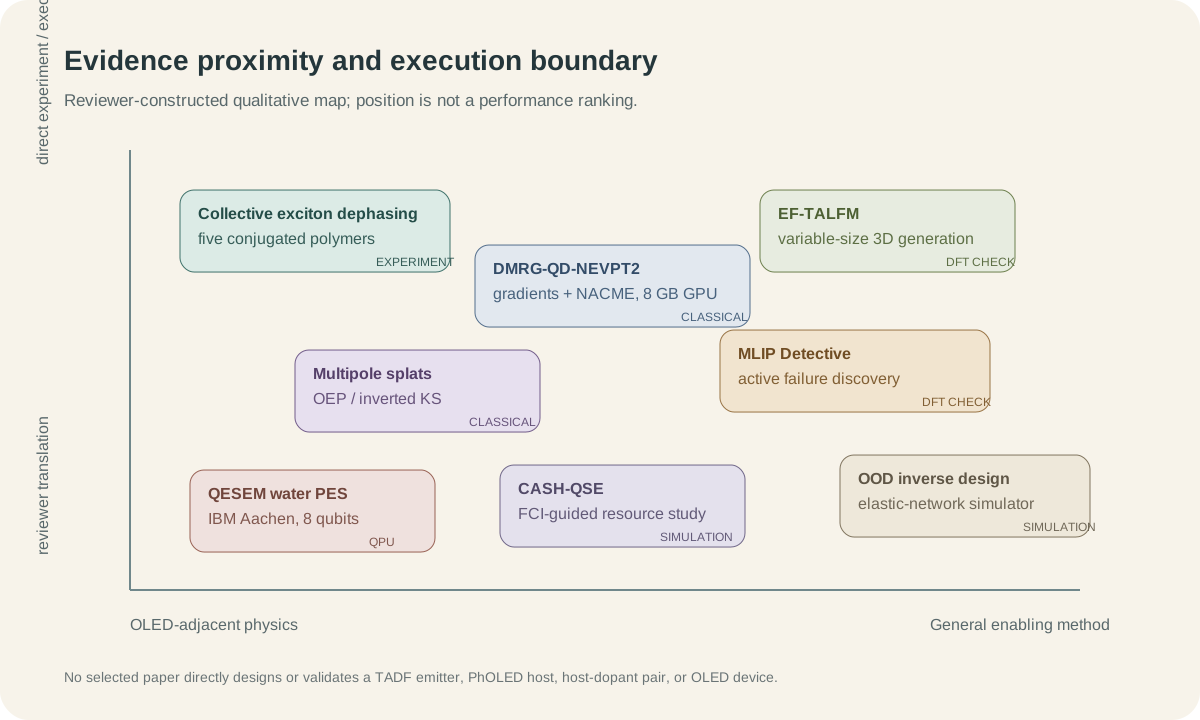
Figure 2. Reviewer-constructed qualitative evidence map. Placement reflects OLED-workflow proximity and what each paper actually executed; it is not a performance ranking. All eight selected items are preprints.
1. No direct OLED, TADF, or PhOLED paper met the threshold
The search found no new primary record that directly designed or validated a TADF emitter, PhOLED host, host-dopant/exciplex system, or OLED device. The eight items below concern organic-semiconductor photophysics or enabling computational methods. Papers covered in the 21 August, 28 August, and 4 September briefs are not repeated.
2. Weak thermal optical dephasing across five conjugated polymers
Henry J. Kantrow, Elizabeth Gutiérrez-Meza, Eric R. Bittner, Hao Li, and Carlos Silva-Acuña posted Collective Excitonic Structure Governs Anomalously Weak Thermal Optical Dephasing in Conjugated Polymers on 6 September 2026.
Source-reported result
The study compares P3HT, P3HHT, PBTTT, PCE11, and N2200 using coherence-detected COLBERT and population-detected two-dimensional photoluminescence spectroscopy. The materials differ in backbone structure, donor-acceptor character, side chains, and solid-state organization. Homogeneous linewidths span about 20-90 meV; N2200 reaches about 20 meV in COLBERT. Every material nevertheless shows weak temperature scaling over its measured range. For PBTTT, 2DPL gives a systematically larger linewidth than COLBERT, while both preserve weak thermal scaling.
Limitation and workflow translation
The paper does not assign a microscopic cause to the linewidth differences. Quantitative treatment of exciton-vibration coupling and relaxation pathways remains necessary, and the preprint’s data-repository URL is still a placeholder. It studies polymers rather than OLED emitters or devices.
An OLED pipeline should therefore place a dimer/aggregate exciton model and observable-specific dephasing test above isolated-molecule S1/T1 and oscillator-strength predictions. Linewidth should be stored with detection mode, temperature, and morphology provenance rather than treated as a molecular constant.
3. Variable-size 3D generation from a fixed-dimensional latent
Weichi Yao, Cameron Gruich, Bryan R. Goldsmith, and Yixin Wang posted Fixed-Dimensional Latent Flow for Generating Variable-Size 3D Molecules on 8 September.
Source-reported result
EF-TALFM samples a fixed-size molecular latent with flow matching. An autoregressive Transformer then generates atom types, coordinates, chemical states, and molecular size. Canonical atom ordering and rigid-pose alignment permit a non-equivariant Transformer to reconstruct the 3D graph. On PCQM4Mv2, 89.4% of samples are simultaneously unique, training-set novel, sanitizable, and PoseBusters-clean, compared with 75.6% for UAE-3D and 69.8% for FlowMol.
The conditional benchmark uses ten HOMO-LUMO-gap targets from 4.1 to 7.8 eV and 10,000 samples per target. Internal ranking approximately doubles the density of DFT values within 0.1 eV of target while retaining 97% novelty among unique verified hits. The reported latent dimension is 32; total training time is 882 minutes versus 1,644 minutes for UAE-3D.
Limitation and workflow translation
A PCQM4Mv2 HOMO-LUMO gap is not an OLED S1, T1, ΔEST, SOC, or condensed-phase performance target. Stability of canonical ordering for larger, nonplanar donor-acceptor molecules, route feasibility, and scaffold-OOD calibration remain untested.
For OLED work, preserve the ability to generate molecular size but re-evaluate shortlisted candidates under one conformer and TDDFT/TDA protocol. Rank scaffold-held-out target calibration and plausible synthesis routes above raw novelty.
4. MLIP Detective searches for failures hidden by benchmark averages
Ryuhei Okuno, Nontawat Charoenphakdee, Kaoru Hisama, and Yuta Tsuboi posted MLIP Detective: Active Failure Mode Discovery Beyond Benchmark Scores for Machine-Learning Interatomic Potentials on 8 September.
Source-reported result
A Detective Agent proposes falsifiable physical hypotheses. Probe Agents screen them with inexpensive simulations, physical constraints, and committee disagreement before expensive human and DFT verification. For MACE-MPA-0, 27 of 40 O- or F-containing combinations in a mixed PBE/PBE+U region predict the relaxed adsorbate-surface system above separated fragments; none of 72 combinations outside that region does.
CO/Cu(111) matches a benchmark adsorption energy within 0.04 eV of experiment, yet its desorption path is defective. MACE-MPA-0 produces a 0.208 eV barrier above the vacuum asymptote, whereas plane-wave PBE on the same 25 images rises only 0.022 eV. A correct equilibrium score therefore coexists with a qualitatively wrong path.
Limitation and workflow translation
The demonstrations cover surface adsorption and a small number of failure families. LLM pretraining exposure cannot be excluded; the human-authored inspection specification bounds the search; final confirmation still consumes expert and DFT effort.
For OLED models, preregister failures such as correct ΔEST with incorrect state ordering, a smooth minimum with a discontinuous torsion scan, or unphysical charge transfer at large host-dopant separation. Escalate only the strongest candidates to high-level calculations.
5. Nonadiabatic derivatives through a crossing on an 8 GB GPU
Rubén Darío Guerrero posted Analytic Gradients and Nonadiabatic Couplings for Device-Resident DMRG-QD-NEVPT2 Through Conical Intersections on a Consumer GPU on 9 September.
Source-reported result
DMRG supplies active-space static correlation; quasi-degenerate strongly contracted NEVPT2 adds dynamic correlation. Gradients and interstate nonadiabatic coupling matrix elements are evaluated as a reverse-mode transpose of a contraction graph. The full stack runs on an NVIDIA RTX 4060 with 8 GB. At twisted ethene, the method produces smooth adiabats and a nonzero, 1/ΔE-divergent coupling through the crossing, where adiabatic linear-response TDDFT returns zero.
The DMRG reference agrees with FCI in the active space to 10^-15, and the single-precision leg changes energies by less than 10^-6 eV. A dense CAS(10,10) four-RDM route would require 12.6 GB; fused contractions use 7.1 GB and agree with the dense result at 8.9×10^-16. An ethene aug-cc-pVTZ Cholesky build falls from not finishing within 40 minutes to about 3 minutes.
Limitation and workflow translation
This is a single-author preprint centered on ethene. Behavior for TADF multistate manifolds, triplets, SOC, host environments, larger donor-acceptor chromophores, and diffuse functions is not established. Use it as an escalation layer for the few candidates with severe CT/LE mixing or crossings, not as a production screen.
6. Multipole splats stabilize optimized and inverted Kohn-Sham potentials
Matija Medvidović, Angel Rubio, and Juan Carrasquilla posted Multipole splats for optimized and inverted effective potentials on 8 September.
Multipole splats impose the correct asymptotic decay on local trial potentials. The authors cast optimized effective potential and inverted Kohn-Sham calculations as variational and supervised Hamiltonian learning. They separate spatial fingerprints of self-interaction, delocalization, and static-correlation errors; recover Rydberg series without an empirical asymptotic correction; and compute exact-exchange source densities for benzene and naphthalene at roughly the 70-electron scale.
This is not an excited-state OLED benchmark. Its practical value is representational: for long-range CT and diffuse excitations, store potential- and density-based diagnostics alongside scalar orbital energies. Basis sensitivity and dependence on the underlying hybrid approximation remain part of the validation ledger.
7. Out-of-distribution inverse design with a dynamics surrogate
Sergey A. Shteingolts, Salman N. Salman, Ron Levie, and Dan Mendels posted Out-of-Distribution Inverse Design of Elastic Networks with Differentiable Graph Neural Network Molecular Dynamics on 6 September.
A graph-neural-network molecular-dynamics simulator is coupled to a short dynamical initialization and physics-based refinement. Although trained only on non-auxetic networks with Poisson ratios from 0.1 to 0.4, it designs values as low as -0.3. Training systems contain 150-200 nodes, while tests extend to 5,000 nodes. A comparable static structure-to-property predictor fails in the extrapolative design regime. Constraints keep bonds above 30% of original length and adjacent angles above 20 degrees.
These are disordered elastic networks, not molecules. The defensible OLED translation is methodological: optimize through a differentiable trajectory with explicit geometric constraints, then rerun the original electronic-structure oracle. None of the reported mechanical performance transfers quantitatively to chemical graphs.
8. Actual QPU execution exposes the cost of error mitigation
Renato Olarte Hernandez and seven coauthors posted Implementing QESEM’s High-Accuracy Error Mitigation on a Quantum Computer: a Water Potential Energy Surface Study on 7 September.
Actual QPU execution
The experiment uses an 8-qubit register on IBM Aachen, a 156-qubit Heron r3 processor. It scans eleven symmetric-stretch geometries of H2O in a (4,4) active space with STO-3G and a one-layer perfect-pairing tiled unitary product state. Ansatz and orbital parameters are optimized classically at statevector level; the QPU measures energies rather than performing iterative on-device VQE optimization.
Raw energies are typically about 500 mHa above the reference. QESEM brings loose 0.1 Ha settings within about 100 mHa; tight 0.01 Ha settings put all but one individual result within 30 mHa, with a 34 mHa maximum, while merged results lie within 20 mHa. One of eleven merged points is directly within chemical accuracy; with a ±5 mHa uncertainty band, five overlap that range.
The merged average shot count is 3,135,921 at the loose setting and 16,762,896 at the tight setting. Tight runs take roughly 0.5-2.5 hours of QPU time per geometry. This is evidence that characterization-based mitigation can reduce bias for an 8-qubit small-basis water PES. It is not OLED-scale VQE or quantum advantage.
9. CASH-QSE avoids remeasuring a classically known reference
Artur F. Izmaylov posted Classical Active-Space Hybrid Quantum Subspace Expansion (CASH-QSE): Quantum Corrections without Remeasuring the Classically Calculable Energy on 8 September.
CASH-QSE retains the CASSCF reference classically and constructs occupation-structured quantum components exactly orthogonal to the reference and one another. It avoids overlap measurements and solves an ordinary Hermitian eigenproblem. Tests cover H2O and N2 bond stretching in STO-3G plus a restricted cc-pVDZ H2O space.
For H2O/STO-3G at equilibrium, the idealized final-energy estimate is 5.6×10^3 shots versus 2.9×10^6 for ADAPT-VQE, a factor of 520. At 3.0 Å it is 3.2×10^2 versus 1.2×10^5, about 370-fold. The largest complete measurement circuits use a few hundred all-to-all logical CNOTs.
Component selection is guided by FCI information, and the figures are idealized sampling estimates, not noisy QPU runs. They omit physical-qubit routing and error-mitigation overhead. OLED translation must begin by testing whether a tractable classical active-space reference retains the relevant CT/LE and spin character.
10. Practical experiment for the coming week
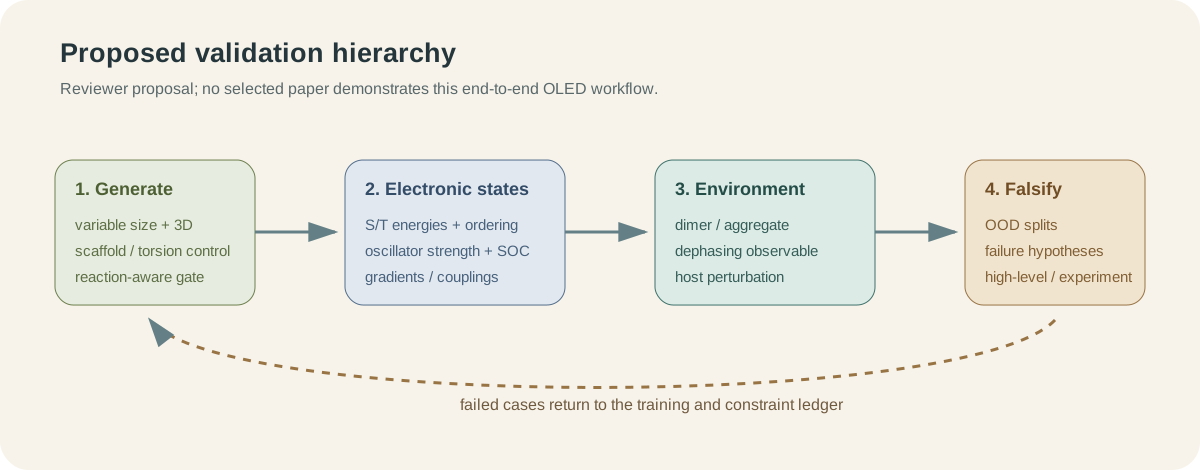
Figure 3. Reviewer-proposed workflow synthesized from this week’s literature. No selected paper executes this OLED pipeline end to end.
Choose a 12-24-member donor-acceptor or host family and construct conformers plus selected dimers. Allow an EF-TALFM-like generator to vary molecular size, but retain only candidates passing reaction-template and commercial-building-block gates. Under one TDDFT/TDA protocol, compute S1, T1, higher triplets, oscillator strength, and NTO-based CT/LE descriptors; add excitonic coupling and host perturbation descriptors for dimers.
Evaluate preregistered failure hypotheses rather than average MAE alone: state-order swaps, discontinuous torsion scans, unphysical long-range charge transfer, and inflated oscillator strengths under scaffold-held-out, torsion-held-out, and dimer-separation tests. Escalate only 5-10 cases to a multireference or larger-basis calculation. Keep QPU work as a separate resource experiment reporting logical circuits, shots, QPU time, and matched classical baselines.
11. Coverage gaps
No credible new item in the seven-day window directly addressed:
- molecular or device validation of a TADF emitter, PhOLED host, or host-dopant/exciplex system;
- OLED degradation, stability, or operational lifetime;
- SELFIES-specific constraints, CRBM, or Boltzmann-machine molecular sampling;
- chemistry-relevant D-Wave/QUBO or QAOA with a matched classical budget;
- VQE resource estimates or quantum advantage for an OLED active space.
Conclusion
The week’s literature separates photoactive molecular design across three scales. Electronic states and crossings must be computed reliably within a molecule; collective excitons and observable-dependent dephasing enter between molecules; and the design loop must actively search for failures outside benchmark distributions. EF-TALFM expands generative freedom, but electronic-structure, aggregate, and synthesis validation determine whether its candidates become OLED materials.
The quantum evidence is equally bounded. QESEM reduces actual hardware error, but its tight setting averages about 16.8 million shots per geometry. CASH-QSE reports much lower idealized sampling cost with FCI-guided component selection, not a hardware demonstration. The supported conclusion is not quantum advantage; it is the need for a complete resource ledger and matched classical baselines.
References
- H. J. Kantrow et al., “Collective Excitonic Structure Governs Anomalously Weak Thermal Optical Dephasing in Conjugated Polymers,” arXiv:2609.06742v1 (6 Sep 2026). Preprint; experiment.
- W. Yao et al., “Fixed-Dimensional Latent Flow for Generating Variable-Size 3D Molecules,” arXiv:2609.08333v1 (8 Sep 2026). Preprint; DFT-verified property hits.
- R. Okuno et al., “MLIP Detective: Active Failure Mode Discovery Beyond Benchmark Scores for Machine-Learning Interatomic Potentials,” arXiv:2609.08399v1 (8 Sep 2026). Preprint; agentic search with DFT verification.
- R. D. Guerrero, “Analytic Gradients and Nonadiabatic Couplings for Device-Resident DMRG-QD-NEVPT2 Through Conical Intersections on a Consumer GPU,” arXiv:2609.09990v1 (9 Sep 2026). Preprint; classical GPU.
- M. Medvidović, A. Rubio, J. Carrasquilla, “Multipole splats for optimized and inverted effective potentials,” arXiv:2609.09280v1 (8 Sep 2026). Preprint; classical calculation.
- S. A. Shteingolts et al., “Out-of-Distribution Inverse Design of Elastic Networks with Differentiable Graph Neural Network Molecular Dynamics,” arXiv:2609.06655v1 (6 Sep 2026). Preprint; non-chemical simulation.
- R. O. Hernandez et al., “Implementing QESEM’s High-Accuracy Error Mitigation on a Quantum Computer: a Water Potential Energy Surface Study,” arXiv:2609.07284v1 (7 Sep 2026). Preprint; actual IBM QPU measurement after statevector optimization.
- A. F. Izmaylov, “Classical Active-Space Hybrid Quantum Subspace Expansion (CASH-QSE): Quantum Corrections without Remeasuring the Classically Calculable Energy,” arXiv:2609.08170v1 (8 Sep 2026). Preprint; idealized resource analysis, no QPU run.
Publication record. Responsible editor: Hyun-Jung Kim. AI assistance: OpenAI Codex Work Mode. Evidence cutoff: 10 September 2026. Numerical values and execution boundaries follow the cited sources; OLED workflow translations and the proposed experiment are reviewer inferences. All eight selected papers are preprints.