
When a reaction campaign introduces a new ligand or substrate, previous yield measurements should be useful. Yet chemical resemblance does not guarantee that the same conditions will remain productive. Historical observations can guide the next experiment well, or keep the optimizer searching where yesterday’s chemistry worked.
Guanming Chen, Priyanka Parihar, Maximilian Fleck and Thijs Stuyver address this problem in Robust Transfer Learning for Bayesian Optimization of Chemical Reactions. Their approach examines the probabilistic model that interprets molecular representations alongside the strategy used to transfer observations. An initial period of direct data reuse is followed by a model that distinguishes optimization stages. Stuyver’s announcement of publication in Digital Discovery provides the occasion to examine this mechanism and its implications for materials research. [1][2]
Prediction matters through the experiments it selects
Bayesian optimization (BO) sequentially models an objective from observed data and chooses the next experiment. For a chemical reaction, an input x may contain ligand, solvent, base, temperature and concentration; the output y may be yield. With too many combinations to test, the aim is to find productive conditions early within a limited budget.
A Gaussian process (GP) supplies a probability model over functions. Conditioning on observations produces a predictive mean and uncertainty for untested candidates. An acquisition function uses these predictions to choose where to measure next. Low average prediction error alone does not guarantee efficient optimization: correlations between candidates and the uncertainty assigned to them also influence the decisions.
The public implementation uses a GP with a Matérn kernel and qLogEI, a logarithmic formulation for numerical stability in expected improvement (EI). In this study, campaign transfer means reusing observations from an earlier optimization. That is distinct from obtaining molecular features from a pretrained representation model. Both can be present in the same workflow. [3][6]
Molecular features need an appropriate distance scale
One-hot encoding distinguishes categories without directly encoding chemical similarity. Hidden-space featurization (HSF) uses internal vectors from pretrained models, such as graph neural networks or Transformers, to convey relationships between molecules. These vectors can increase input dimensionality substantially, making the way the GP interprets distance consequential.
The kernel’s length scale controls how far inputs can differ while remaining correlated. If it is too short, nearly every candidate can appear unrelated to the observations. A hyperprior places a prior distribution on a kernel parameter. Its influence can be substantial when only a few measurements are available.
As an explanatory calculation, let each coordinate of two vectors be independently uniform on [0, 1]. With d coordinates,
This assumption makes a characteristic distance grow as √d. Real molecular embeddings are correlated and anisotropic, so this is an illustration rather than a statistical model of the actual features. It explains why fixing the same length scale across representations can be problematic. Adjusting for dimension provides a better starting point; it does not certify that a representation contains useful chemistry.
The earlier paper by Chen, Fleck and Stuyver reports that mismatched length-scale hyperpriors can flatten the marginal-likelihood landscape and impair surrogate fitting and acquisition optimization. Published online in the Journal of Chemical Theory and Computation on 15 May 2026, it proposes a hyperprior with a characteristic length scale that grows with √d. The publisher-hosted abstract reports improved use of hidden-space representations across the studied reaction benchmarks. This does not establish universal superiority in high-dimensional optimization. [4][5]
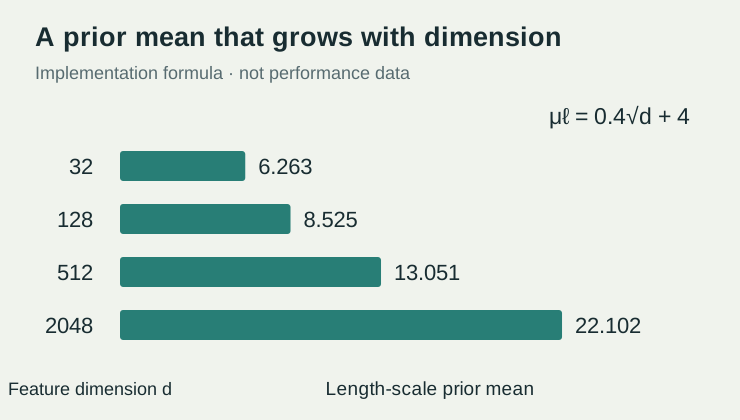
adaptive_emilien implementation. Dimensions are illustrative choices, not reported dataset dimensions or performance measurements. Source: author code; original reconstruction for this review.In the inspected code, the CHEN prior uses μℓ = 0.4√d + 4. The length-scale prior is Gamma(2μℓ, 2), while the output-scale prior is Gamma(μℓ, 1), using shape–rate notation. Both change with dimension in this implementation. Consequently, an observed improvement should not automatically be attributed to a length-scale-only intervention. The constants 0.4 and 4 are empirical implementation choices, not universal parameters to copy without matching feature preprocessing and normalization. [3]
How much should old and new observations share?
The new study addresses expansion to previously untested chemical options. Its registered abstract reports that direct reuse of historical data is effective across the considered benchmarks, while deliberately constructed stress tests expose cases where misleading information substantially impairs optimization. This is negative transfer: using source observations makes target optimization worse than an appropriate target-only baseline. A changed ranking of chemical options can direct acquisition toward regions that no longer perform well. [2]
| Strategy | Use of previous observations | What to assess |
|---|---|---|
| No transfer | Start with target observations | Baseline efficiency and initial measurement cost |
| Direct transfer | Pool observations without a task parameter | Early information gains and misleading similarity |
| Task-aware from the start | Use a task parameter immediately | How much task structure can be learned with little target evidence |
| Two-phase transfer | Pool initially; introduce a task parameter after P iterations | Whether early gains survive while later differences are accommodated |
This table describes implemented comparators, not their performance ranking. The authors explicitly state that no strategy is universally optimal. They propose the two-phase protocol as a robust default when source–target similarity is uncertain. [2][3]
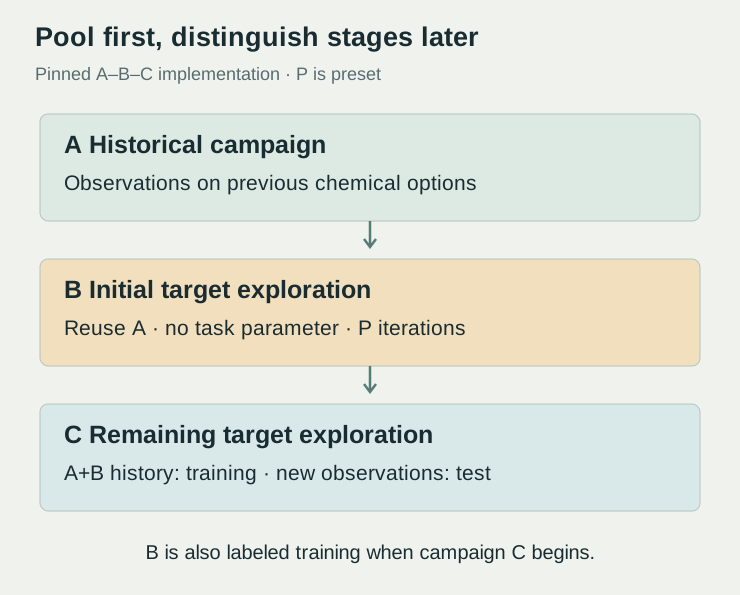
training history when C starts. This is not data deletion or automatic similarity detection. Source: transfer_loop.py.A task parameter marks the task associated with an observation so that the model can account for task relationships. In the inspected implementation, P is a preset iteration count; the example script compares 5, 10 and 15. It does not contain an online detector that identifies a loss of similarity and decides when to switch.
A further detail matters for reproduction. _collect_init_data_B merges observations from A and B. Subsequently, run_phase_2(..., use_task_p=True) labels all of A+B as training, and the new C observations as test. The pinned implementation therefore separates accumulated pre-switch history from subsequent observations, rather than simply preserving the original source-versus-target chemical identity. This code observation does not establish the authors’ intent or the correctness of the final published method. A reproduction could compare this setting with persistent source/target membership. [3]
What the public implementation establishes
TL-ChemBO specifies BayBE 0.12.2 and loads the Shields and Buchwald–Hartwig reaction datasets. Outcomes of recommended conditions are retrieved from existing tables. The inspected workflow is therefore a retrospective optimization simulation using experimental data. It provides no basis for describing this code as a new prospective reaction campaign or an OLED device demonstration. [3]
| Item | Observed setting | Interpretation |
|---|---|---|
| Campaign length | N_ITER_ALL = 30; target batch size 1 | Implementation settings, not an experiment-reduction percentage |
| Initialization | Target-only baseline begins with 5 random recommendations | Cost comparisons depend on whether acquiring the source data is charged |
| Switch points | P = 5, 10, 15 in the example | Not universal optima or automatically selected values |
| Metrics | Best-so-far yield, normalized area under that curve, final yield | Early discovery and final outcome are different metrics |
| Representations | Branches for one-hot, Mordred and pretrained vectors | Available options do not prove that every combination appears in the paper |
The best-so-far curve records the highest yield found by each iteration. Two methods can reach the same final yield while the one finding good conditions earlier has a larger area under the curve (AUC). The implementation integrates the averaged curve with the trapezoidal rule and divides by the reference maximum yield times the last experiment count. This optimization metric is neither classification accuracy nor a success probability. It does not automatically add a point before the first observation, so the starting x-coordinate must also match in a numerical reproduction. [3]
This review did not execute complete BO campaigns. Qualitative claims from the registered abstract, observed code settings and explanatory calculations are identified separately. The final paper and supplement are needed to evaluate average gains, run-to-run variability, worst-case transfer losses and sensitivity to P.
For OLED research, separate chemical shifts from calculation shifts
Materials discovery presents a related opportunity: reuse calculations or measurements from an established molecular family when exploring a new scaffold or donor–acceptor combination. However, reaction-yield transfer does not establish transfer performance for excited-state energies, emission rates, degradation or device lifetime.
The following is a proposal from this review. Split historical and target data by scaffold or chemical family. In a retrospective campaign, reveal target labels only when a candidate is selected. Hold the candidate pool, initial data, budget, representation and GP settings fixed while changing the transfer strategy. Compare representations separately to distinguish gains from molecular features from gains due to historical observations.
When reusing density functional theory (DFT) data, record functional, basis set, solvation model, geometry treatment and state definitions. Otherwise the model can confuse changes in chemistry with shifts in the calculation protocol. Begin with comparable labels; if combining different calculation levels, model that distinction explicitly.
Report average optimization performance together with the fraction of target families harmed by transfer, uncertainty calibration on new families, and calculation or experiment cost to reach the objective. Choose P on separate development families rather than after examining test outcomes. Distinguish marginal cost when historical data already exist from total cost when those data must first be acquired.
Switching rules and failure cases deserve closer study
Useful follow-up directions include observation-driven switching, selecting helpful records from several source campaigns, and handling multiple measurement or calculation fidelities. A new switching rule should be evaluated with the cost of the observations it requires. Dimension scaling also leaves open the effective dimension, correlations and irrelevant directions of actual molecular features.
The supported message is that the usefulness of molecular representations depends on GP configuration, and that historical observations need a mechanism for accommodating differences revealed during the new campaign. Two-phase transfer is a concrete comparator for testing this balance. Its practical value for OLED discovery requires evaluation on new scaffolds with consistent property definitions.
Primary sources and reproduction material
- Chen, G.; Parihar, P.; Fleck, M.; Stuyver, T. Robust Transfer Learning for Bayesian Optimization of Chemical Reactions. Digital Discovery (2026). Publication DOI · Author announcement. Publication metadata checked; journal full text and supplement not inspected.
- Preprint v2: ChemRxiv DOI · Crossref abstract and metadata. Complete registered abstract checked; detailed differences from the journal article remain unverified.
- Official TL-ChemBO code, commit
a35276c. Inspectedtransfer_loop.py,base/kernels.py,base/transfer_utils.py,base/benchmarking.py,run.shandrequirements.txt. Source inspection and limited setting checks; no independent reproduction of complete campaigns. - Chen, G.; Fleck, M.; Stuyver, T. Leveraging Chemical Hidden-Space Representations Effectively in Bayesian Optimization for Experiment Design through Dimension-Aware Hyperpriors. J. Chem. Theory Comput. 22 (11), 5594–5608 (2026). DOI. Published online 15 May 2026.
- ACS-hosted collection and abstract for the earlier study.
- Ament, S. et al. Unexpected Improvements to Expected Improvement for Bayesian Optimization. arXiv:2310.20708. Further reading on the numerical motivation and formulation of LogEI.